

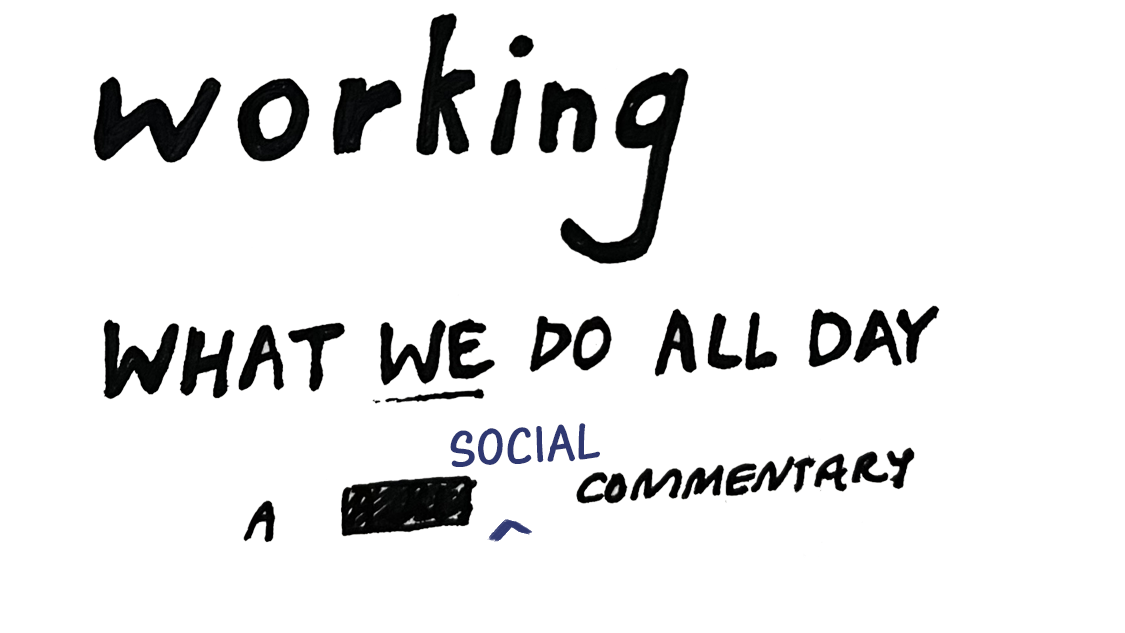
R and I started watching a docuseries called Working, hosted by the popular face of Obama. It is a four-part series, based on Studs Terkel’s nonfiction book Working, that explores what employment looks like in capitalist America across the hospitality, technology and home care sectors. The conversations are set in – The Pierre Taj Hotel (hospitality), Aurora Technologies (tech) and the At Homecare Solutions Inc. (Home care)
In the trailer, Obama asks what makes a “good” job good across all levels of the workforce while documenting individuals at their workplace and home, contrasting them and collectivising them in some way as human.
“We may not think about it, but we’re all a part of something larger than any single one of us,” Obama says. “Work is one of the forces that connects us.”
It’s a heterogenous group, diverse personalities, races, ethnicities and nationalities. The show reveals the juxtaposition of the sexual, social and international divisions of labour. It only reveals to those that are looking out for it, but it fails to question it every chance it gets.
Firstly, where are the women? And if we are to alter the gaze, why is it dominated by men? Why are women over represented in roles that offer ‘care and support?’ I had a lot of questions, it is alarming how much one can learn through this series about the hierarchies of caste, class and gender that structure Indian society both within and outside of its geographical borders.
The first episode titled ‘Service Jobs’ documents the days of Elba, a housekeeper at the Pierre Taj Hotel in New York, Randi, a home care aide and Carmen, an Uber eats driver. All women. All women of colour. Two of them are single mothers. It may have been the writer’s call to highlight women voices in the sector, but inadvertently, they’ve also shed light on the direct co-relation between women and service.
A lot of feminist literature draw attention to exactly these types of work that capitalisation and globalisation has cubbie holed for most non-white women in the world, mainly employment in the service sector as evidenced in this series.
In the past month, I’ve been reading Maria Mies’s book on patriarchy and accumulation on a wold scale. She astutely notes, “women’s household and child-care work are seen as an extension of their physiology, of the fact that they give birth to children, of the fact that nature has provided them with a uterus.” This doesn’t extend to caring just for their children, but for all those that need attention. She further adds, the sexual division of labour is social and not ‘natural’; colonization and housewifization are active processes by which (male) strategies of capital accumulation are imposed and furthered.
As the series progresses, we are acquainted with . In episode two titled ‘The middle’, we are introduced to two women. Beverly is a switchboard operator at the Pierre Taj hotel and Sheila is a supervisor at AtHomecare Solutions Inc. They both have worked their way up to these positions starting from the very bottom. In the last episode, we dwindle down to one woman at the highest level of power – The boss level. Jeanette leads a home care organization in Mississippi. Jeanette pays herself a lesser salary than a typical CEO, to better support her workers and clients who are not valued enough by the United stated medicaid services. Care work is often associated with women. Women are attributed to being more patient, nurturing and empathetic. Whether this is backed by science and biology is secondary. This gendered notion has noxiously pervaded the labour market and still decides the division of labor in human society.
As Maria Mies writes sharply, ‘we are not asking: when did a division of labour arise between men and women? (Such a division is a necessary consequence of all human interaction with nature.) Our question is rather: why did this division of labour become a relationship of dominance and exploitation; why did it become an asymmetric, hierarchical relationship? This question still looms over all discussions of women’s liberation.’
In fact, in the episode titled Dream Jobs, there are no women at all. The tech industry for the longest time has valorised the focussed, determined and gloriously male entrepreneur and his friends, think Mark Zukerberg and whoever Justin Timberlake plays in the movie. In this episode, in the tech sector, we meet Karthik, the Lead Engineer at Aurora Technologies. In the hospitality sector, we are taken on a tour by François, through the Pierre Taj Hotel. As he walks around interacting with the staff, there is a striking imbalance in the gender and racial backgrounds of the staff at the lower levels of service, compared to the leading ones. It is hard, unentangling race, class and gender in the organisational chart at any of these workplaces, they’re so tightly interwoven, yet so little spoken about. It’s only implicit. The last person featured from the home care industry is a lobbyist that works for At Homecare solutions Inc. He discusses firmly in his political circles, the visible impact of racism at work and homes, in the constituencies he represents. Then, we get a peek into his home, his wife and children and I particularly like these scenes because it’s a whole family chiming in and contrasting the realities of employment today, the trust funds for children and the flexibility of working from locations of choice. His wife, Bobbie-Ann, speaks about her mother and grandmother-in law who supported them by caring for their children since they didn’t have to go to work. At the end of it, we meet Apoorva, Karthik’s wife, after a microscopic study into her husband’s dreams and aspirations. And it is in this very role that she is introduced to us, despite having a flourishing career of her own, which we later learn. She sits down to speak to Obama about how she manages this said career amidst caring for their child, with grace and elegance. We don’t get any details about her dreams. Poornima, a colleague of Karthik’s quips, all that software engineers want to do is save the world, that is the most important thing and I think to some extent it is true. But there is ambivalence in this world, they are looking to save fails everyday to understand the masculine, dominant sexist ideologies that dictate the industry.
In the episode titled ‘The Boss’, Lalitha Chandrasekaran, the wife of N Chandrasekaran makes a short appearance to accentuate her husband’s persona. Though the question isn’t heard, through her answer we know she is asked what she understands about her husband’s work and the going-ons in the office. She responds with knowledge of the company’s complicated businesses, but what she says after, is the crux of the argument in my head. She says, I know it, one can feel the body language, but he’ll always have a smile on his face.’ She doesn’t answer the question with what she makes of what she knows, but directs it to back to the workman. There’s a visible line of the home and workplace in this response and it irks me. The question itself is leading, pushing her to place her husband’s work at the centre of it, but the fact that her response is so normalised is even more bothersome. There’s always a pressure on women to ‘know’ and ‘sense’ the moods of those around her without intruding into the causal reasons.
The series ends with a beautifully delivered monologue by Obama, “We may not think about it, but we are all a part of something larger than us, and our work is one of the forces that connects us and when we make sure that everyone feels their work is respected, that everyones contribution is honoured, and that everybody is getting paid to truly take part in the life our communities, we reinforce the trust between us that everything in our lives is possible” The video in the background showed the men in the series partaking in leisure, wheras the women were at work, the work that their hearts desired.
Work and respect are incompatible things in the everyday society of India and not just for women. Caste and class underline all work, everywhere.
Jeanette thinks aloud for all of us watching from various social backgrounds and locations, “As time moves on, you just try to do the best with what you have and keep the ball rollin on, that’s all you can do. With a little time and a little faith, we can get it done.
 namratanarendra.com
Leave a comment