
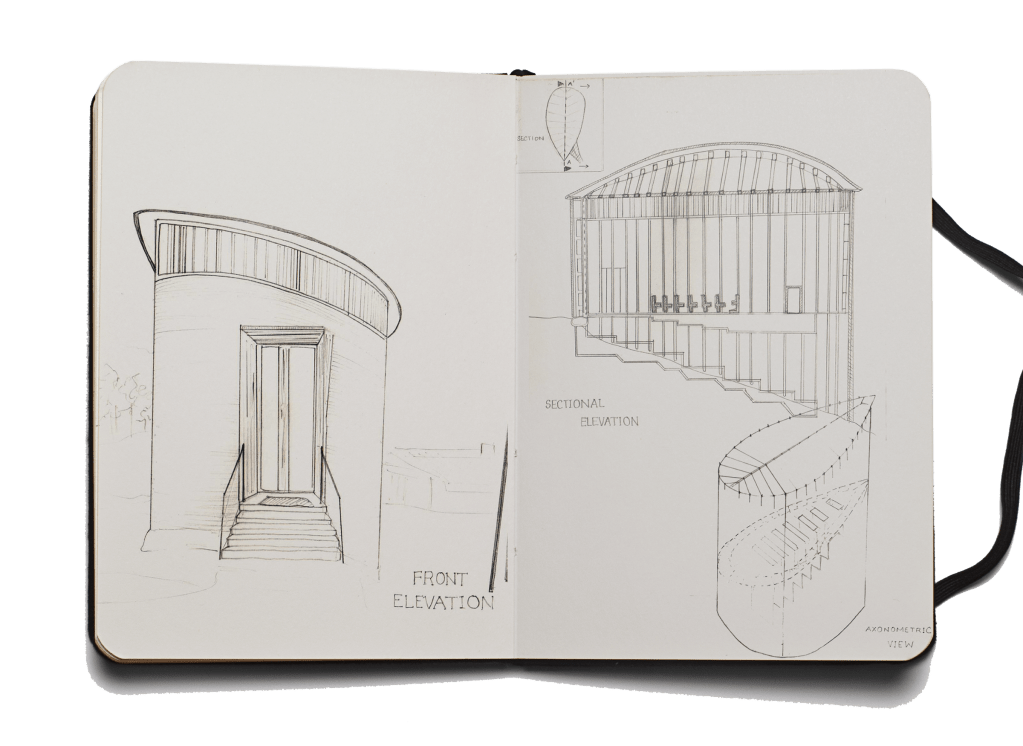
Personal drawings from 2014; St. Benedict’s Chapel, Switzerland – Designed by Peter Zumthor
For the past two nights, I’ve been sitting, scouring through countless files in my hard drive for an assignment I had turned in during my first semester of architecture school. It was a space exploration exercise, a study of a building designed by Peter Zumthor, in Switzerland.
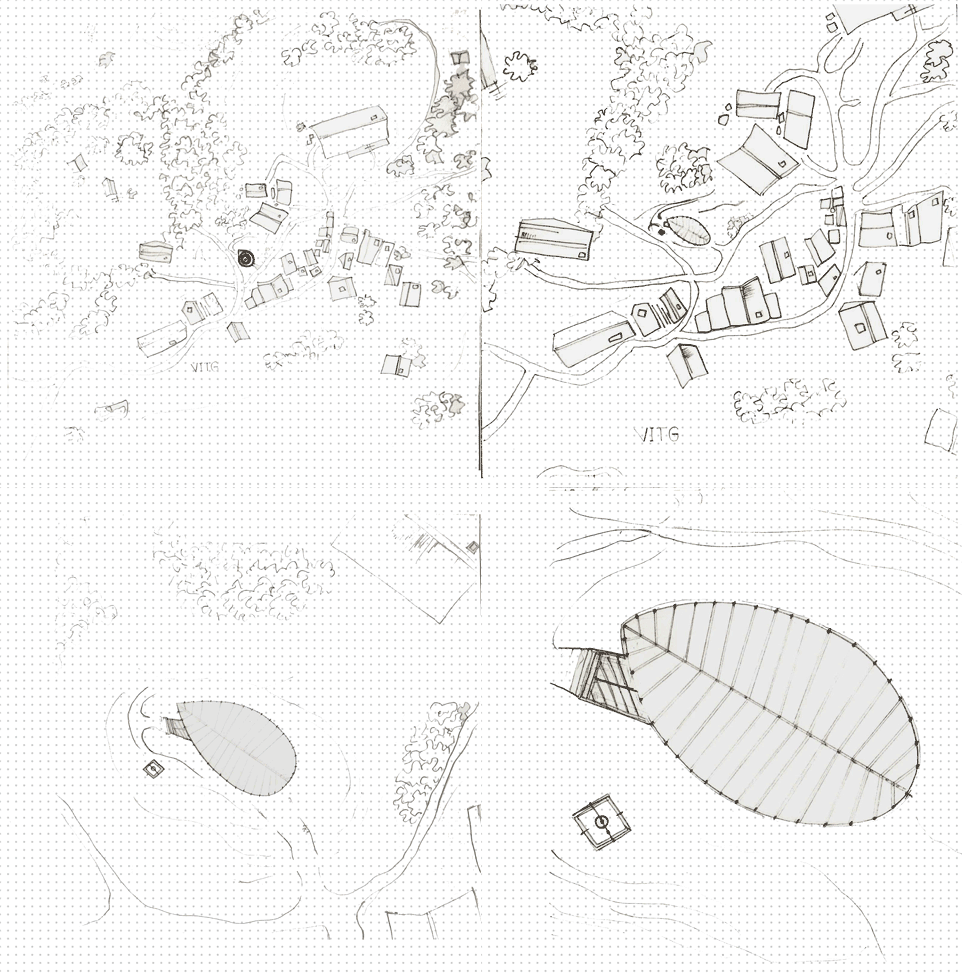
Sitting in India, I was asked to feel the built and unbuilt spaces around a Chapel in the remote village of Vitg. I was expected to articulate the play of light and vivid spatial experiences through drawings and words clothed by the romanticism of the profession. My timid sketches were too raw, my jargon- free words, too normal and naked. I was thinking of why the exercise felt so eerie and distant when I was asked to do it. It certainly wasn’t because of the building or the architect or the location, since I continued to borrow from his principles of experiential spaces and textures throughout my architecture education.
It is only now, ten years later, that I am able to understand the unnatural expectation from that exercise. I was trying to draw a building, through photos, through words, but not through people, through perception, through experiences, through everyday use. So much written about a building, so many photos taken, but not a single one capturing a person or their movements in and around the building. A quick google search of Saint Benedict’s Chapel, will show you human free results too.
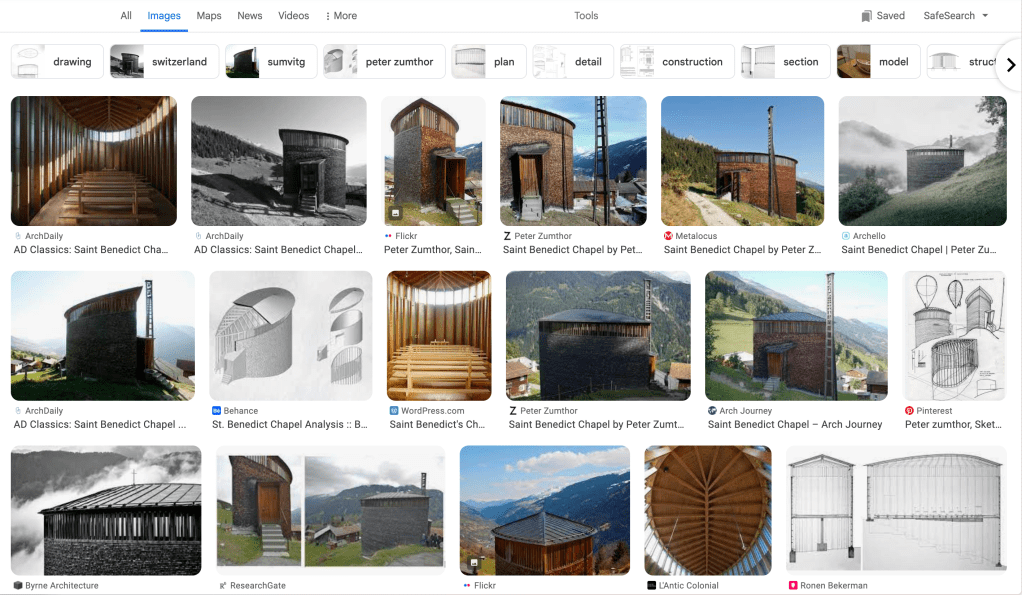
This is an unfortunate truth not just for Zumthor’s work, but for most architect designed buildings. This discipline for the better part enforces implicitly, organization of bodies in space rather than organizing spaces for and around them.
I had an opportunity to interact with Peter Zumthor all those years after repeatedly drawing out his building until my hands could trace the lines of all the walls in my sleep. I told him this very thing, and he smiled softly and said, ‘I didn’t think a lot of people knew of that building.’ He is currently working towards designing an archive for his works.
–
“Looking at a circle is like looking in a mirror. We create and respond irresistibly to circles because we recognise ourselves in them. The circle is the reflection of the world’s – and our own – deep perfection, unity, design excellence, wholeness and divine nature” (Schneider 1995)
A recurring question in most conversations with other architects is who owns the idea of a building once it is designed and built? People populate structures, make it their own by adapting, appropriating and amending. When architects design archives, museums and exhibits for their work, it loses the very connection it was designed to build with the people, with everyday use and function. Glossy ideas photographed, lose shine overtime, but the ideas of the buildings and their physical structures themselves are repaired, remade and rethought by so many, which fail to make it into these curated archives.
This is not to say that museums and archives must be done away with, but the people that architect a building, once it is designed and constructed have also created something unique. The profession of architecture is a created need or manufactured desire, not a necessity. While underserved communities across the world have built and designed their own dwellings, there is little luxury and privilege for creating experiential textures and spaces. However, there is innovation in material and space. But these experiments in incremental construction are not archived, not by the people, neither by the architects and much less by students like me, who were shown the works of ‘star’chitects.
–
The event where I met Peter Zumthor, was a lunch organised to bring all the ‘top’ architects of Bangalore together to have a meet and greet of sorts with Zumthor. This was one stop on his pan Indian tour organised by a Swiss Institute.
In that moment, I was transported back to my university, ten years ago, talking to the same architect-teachers. Nothing had changed in ten years. Since then, I have graduated from that program, and another, I’ve gradually left it behind me and yet the same people who were dominating the architectural circles then, are continuing to do so now. I may have come full circle with my conflicted professional journey, but this discipline is stuck, untouched by ideas of what it means to build collectively, to challenge hierarchy and inequity in housing and infrastructure. Architect has continued to be just a noun, ceasing to transform into a verb of architecting, of continuously changing.
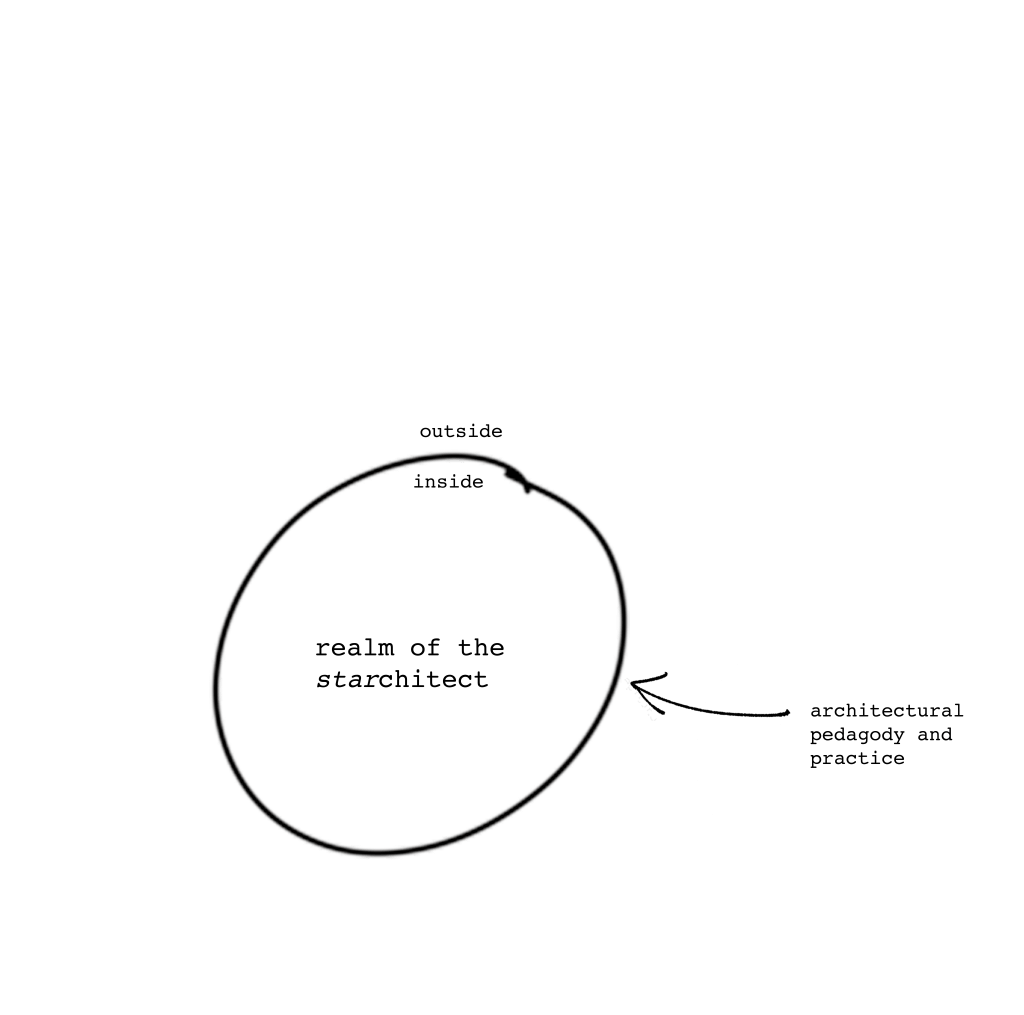
Architectural pedagogy and practice presented as a circle – no visible hierarchies: But a huge divide between the inside and outside, a big threshold to cross into the ‘star’chitect realm. The discipline has a long way to go in reframing ways of teaching, working and reflecting. Moreover, the circles need to break, become porous, build towards an equitable and accessible network of facilitators and intermediaries.
 namratanarendra.com