

Role
Artistic research
Collaborators
Anastassia Vybornova and Trivik Verma
Year
2025
This paper scrutinises the long held belief that individual preferences and behaviours can explain systemic social and spatial inequality in the design of our cities. The images for this paper are anchored in the idiom of “dealing a bad hand.”
The primary image discusses the interconnected four spheres of perpetuation of individualistic bias – Education, Computational modelling, policy-making and public discourse. Education especially on computational methods, continues to be an elitist project, which directly shapes who get to inform policy-making and become power brokers that determines peoples’ lives within a city. This is also reflected in what is reproduced in public discourse.
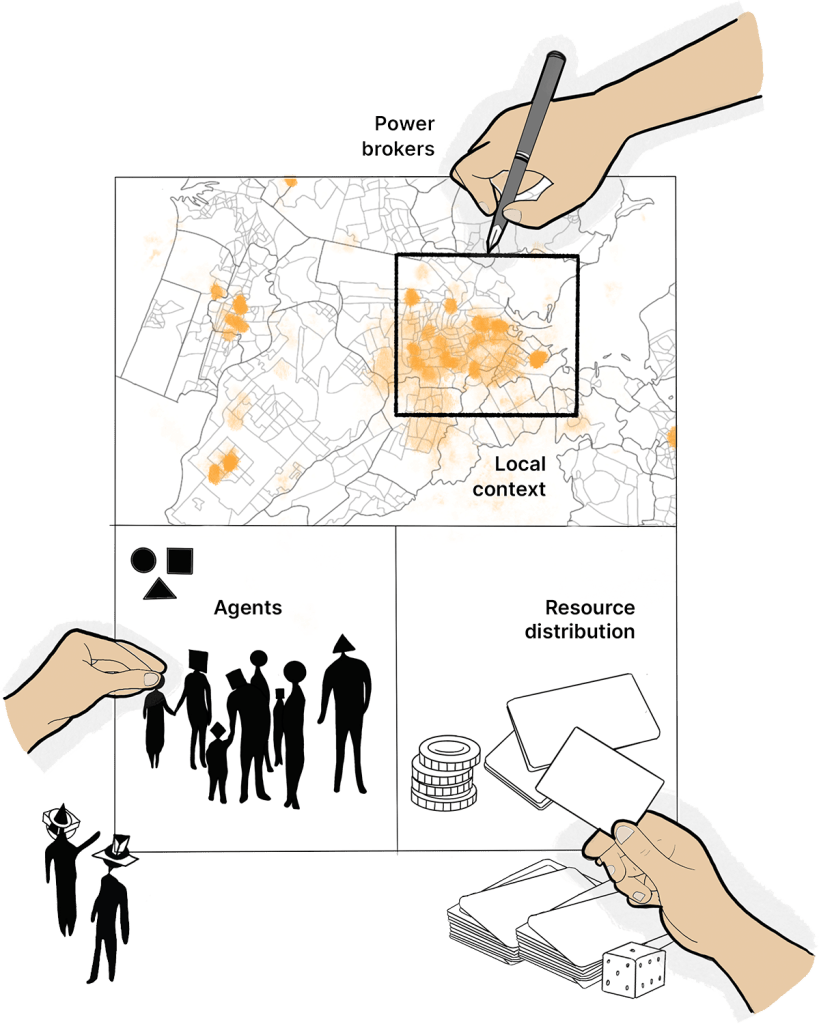
This image introduces the readers to the spatial context wherein we are studying the different ways segregation impacts “agents” – People with multifaceted identities are here modelled as anonymous agents and reduced to single identity lines, such as race, caste or ethnicity. Resources too are gatekept by power brokers who decide how to distribute it and in extension shape policy.
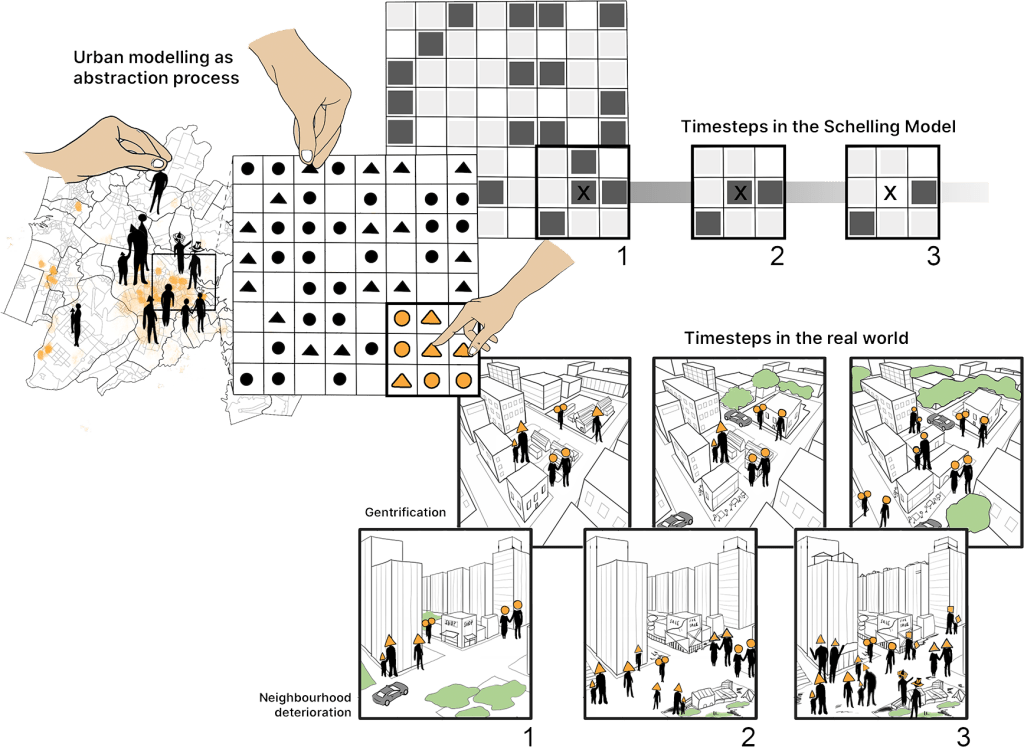
Here, the timesteps of the Schelling model of both the ingroup (residents moving into a gentrifying neihbourhood) and outgroup (residents moving out to a more deteriorated neighbourhood) agents are shown alongside the ground reality in these two neighbourhoods.

Spatial inequalities exacerbate the skewed resource distribution along the different axes drawn above in the form of cards – such as labour, education, health, social networks, and gated resources. These axes manifest differently in the advantaged (top) and disadvantaged(bottom) neighbourhoods.
 namratanarendra.com